February 25, 2026 · 4 min read
Three Problems Every AI Image Tool Ignores
The generation problem is solved. The workflow problem is wide open. Here are the three structural failures in every AI image tool — and what sessions reveal about fixing them.
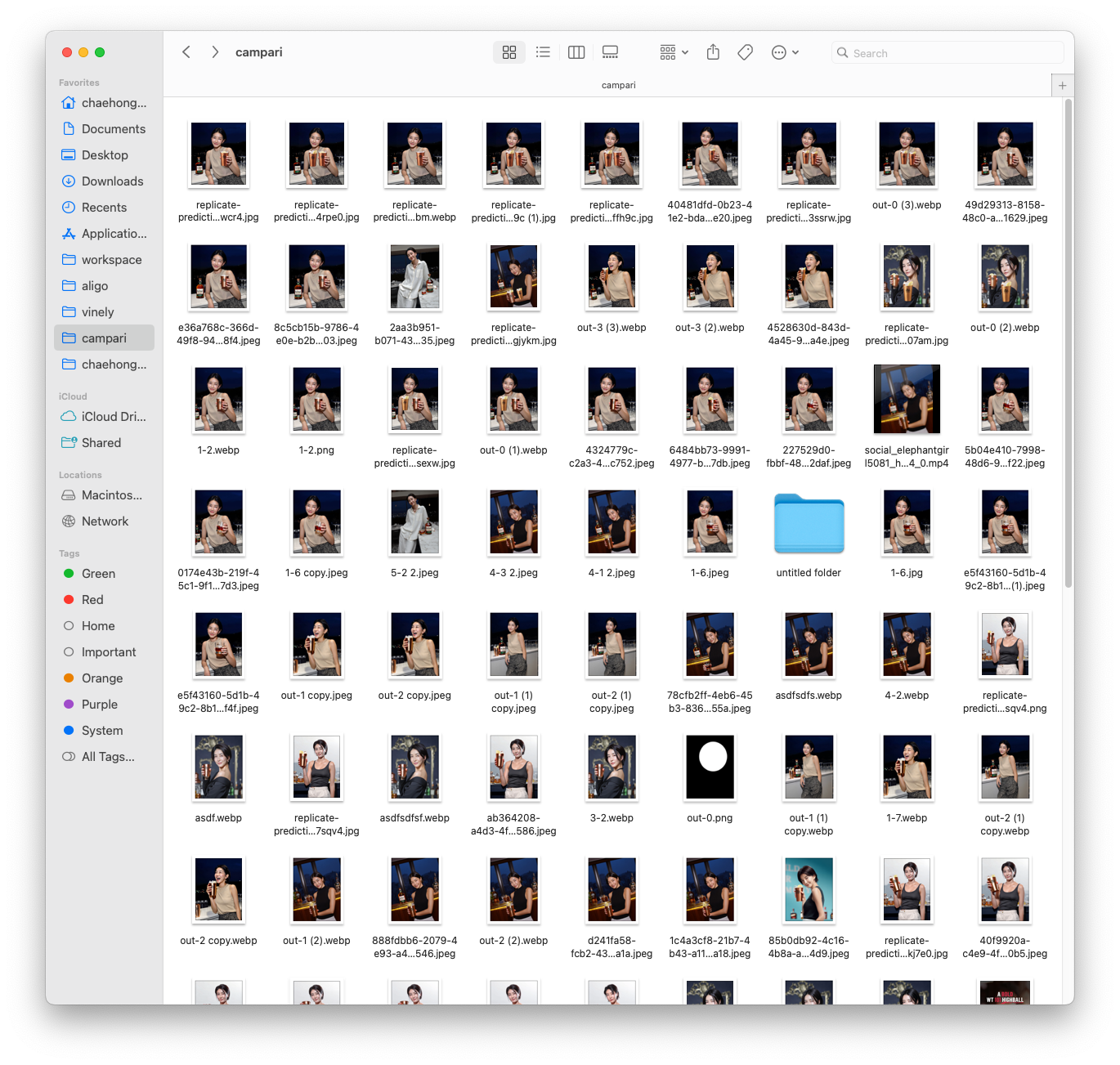
That folder is real
Sixty-something AI-generated images from a single project — replicate-predicti...wcr4.jpg, out-0 (3).webp, 1-6 copy.jpeg. No prompts attached. No history. No idea which one was the good one or how I got there.
This is what every AI image project looks like without version control. And if you've done any serious work with Midjourney, ChatGPT, or Stable Diffusion, you have a folder that looks exactly like this.
I ran dozens of sessions while building aether studio — and every one exposed the same three structural failures in how AI image tools work.
Three problems
1. Linear tools for non-linear work
Chat interfaces force a linear conversation. But creative work branches — you try direction A, then B, then go back to a variant of A with elements from B.
Before Git, developers saved files as final_v2_FINAL_really-final.js. Right now, AI creators have out-0 (3).webp. Same problem, different decade. Git didn't just make engineering neater — it fundamentally changed what was possible. Feature branches meant teams could experiment without risk. The commit history became a living record of every decision.
Creative AI is at this exact inflection point. A chat thread can't represent branching exploration. A visual graph can.
2. No process memory
The final image tells you nothing about how you got there. What was the prompt? What parameters did you use? What did you try before this that didn't work? That's how you end up with a folder of sixty files named out-2 copy.webp — the images survive, but the decisions behind them are gone.
In one session, I composed a Spotify playlist cover from multiple references — a model, an outfit, a cat, a compositional frame — then refined it across six stages: casual to moody to zoomed to face-swapped to upscaled.
Each stage was a decision. In ChatGPT, those decisions evaporate. When your process has memory, each decision is a node you can return to.
3. Exploration feels risky
In another session — a Met Gala dress design — I tried different hairstyles: long and voluminous, a restyle, soft waves.
In most tools, trying "soft waves" means accepting that "voluminous" is gone. That makes you conservative — you don't try the wild idea because you might lose what you have. When every direction is preserved as a branch, exploration becomes free.
The compound interest of process
Version control for creative work doesn't just preserve the process — it compounds it. Every session becomes a library of proven approaches. The Spotify cover's mood progression. A 21-image fashion lookbook spanning New York to Seoul. The Met Gala dress's iterative refinement. Each one is a reusable pattern, not a lost conversation.
Every project teaches the next one — but only if the process is visible. This is what text as a lossy interface looks like in practice — when the tool preserves context, you stop describing and start directing.
What's next
The generation problem is solved. The process problem is wide open.
Nobody should end up with a folder of sixty unnamed files and no memory of how they got there. You can see what the alternative looks like in From Prompt to Lookbook.
More posts